Choosing a time registration app: what to look for
Five questions before you choose a time registration app: price per employee or per company, ways to clock in, projects and invoicing, Dimona and Check in at Work, and help getting started.
The Belgian government wants every employer to record their employees’ working time from 1 January 2027, with until the end of March to set up a system. But there is no law yet. This page explains what is on the table, what is still open and what you can already do. When something changes, we update it.

Not yet for every employer. There is a preliminary draft bill from the Minister of Employment, David Clarinval, which adds a new article 38quinquies to the Labour Act of 16 March 1971. On 30 September 2026 the National Labour Council gave a split opinion on it (no. 2.499): unions and employers disagreed on several points.
Next, the government has to approve the text, ask the Council of State for its opinion and file a bill in the Chamber. The obligation only applies once the bill is voted and published in the Belgian Official Gazette. At the time of writing, no bill has been filed. So 1 January 2027 is the date the government has announced, not a date set in law.
In 2019 the EU Court of Justice ruled (case C-55/18) that member states must require employers to measure each worker’s daily working time with a system that is objective, reliable and accessible. Belgium has not yet turned that into a general rule. The draft bill is meant to do so.
No. The draft does not prescribe a method: an app, software, a badge or a time clock all qualify. Paper or a spreadsheet is not explicitly banned either. The system does have to be objective, reliable and accessible. A list filled in on Friday for the whole week, or one that anyone can change afterwards, proves very little during an inspection or in a dispute about overtime. A system where employees clock in and out themselves, at the moment itself, stands much stronger.
Under the current text, managers and staff in positions of trust, sales representatives, travelling staff and homeworkers, including teleworkers, are excluded. That list is not final. Unions argue the exclusions go against EU law, while employers want more of them. So do not count on your teleworkers or field staff being out of scope.
Apart from the new obligation, some rules already apply:
You can wait until the law is voted. But then there is little time left for your team to get used to it. If you start now, you can test calmly and have a working system in place when the obligation begins.
If you are unsure what the rules mean for your situation, also ask your social secretariat.
In Flextime your employees clock in and out the way that suits their work: in the browser without installing anything, with the phone app, on a tablet, with a QR code or with a badge. You see each person’s actual start and end times, more than the draft asks for, and you can check, correct and export them as PDF or CSV. Flextime Basic costs €24 a month billed yearly, or €29 a month, for up to 30 employees. You pay per company, not per employee.
Flextime Standard, at €50 a month billed yearly, adds rosters, leave, automatic breaks, Dimona declarations, Check in at Work and the export to your social secretariat. You can also book hours per project or client, ready to invoice. Your free trial runs for 14 days, and we help you set it up.
Is your question not listed? Call +32 56 50 50 50 or e-mail info@flexwise.be.
That is not settled yet. The government aims for 1 January 2027, with until the end of March to set up a system. As of 25 November 2026 there is a preliminary draft bill, but no bill in the Chamber yet. The obligation only applies after the vote and publication in the Belgian Official Gazette.
No. The draft does not prescribe a method. An app, software, a badge or a time clock all qualify, as long as the system is objective, reliable and accessible.
The draft does not explicitly forbid it. But a list filled in afterwards, or one anyone can change, proves very little during an inspection or in a dispute about overtime. A system where your employees clock in and out themselves, at the moment itself, stands much stronger.
Under the current text: managers and staff in positions of trust, sales representatives, travelling staff and homeworkers, including teleworkers. That list may still change: unions want fewer exclusions, employers want more.
Probably five years, as already applies to flexible working hours. In their opinion to the National Labour Council, the unions asked for ten.
Five questions before you choose a time registration app: price per employee or per company, ways to clock in, projects and invoicing, Dimona and Check in at Work, and help getting started.
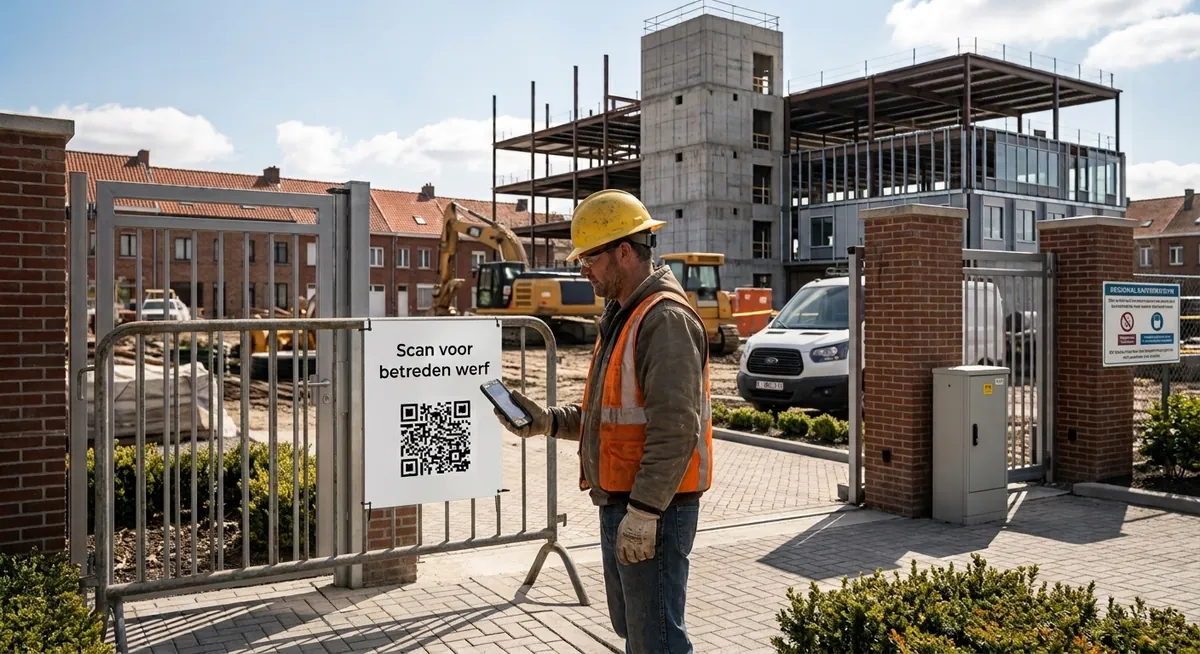
From 1 April 2027, workers on Belgian sites worth €500,000 or more register departure as well as arrival (CIaO). What changes, which sites, how to prepare.

Rond de feestdagen komt verlof binnen via mail, berichtjes en de gang. Hoe medewerkers in Flextime verlof aanvragen en u alles in één overzicht goedkeurt.
Request your free trial. We will call you within two working days to set everything up together.
Flextime is a product of Aditco Flexwise from Roeselare, Belgium, developed and hosted in the EU. We also offer mobile plans, VoIP, business internet and custom software (site in Dutch).
Start now and pay nothing until 1 January 2027. Prepare for the planned obligation at no cost, so your team already knows the system by then.