Choosing a time registration app: what to look for
Five questions before you choose a time registration app: price per employee or per company, ways to clock in, projects and invoicing, Dimona and Check in at Work, and help getting started.
On a Belgian building site or at a client's premises, you register attendance through Check in at Work (CIAW) or Check in and out at Work (CIaO). When someone joins or leaves, you declare it through Dimona. They are two separate declarations to the National Social Security Office (RSZ/ONSS), and many apps only handle one of them. Here is what each one asks, who it applies to and how you handle both from Flextime.
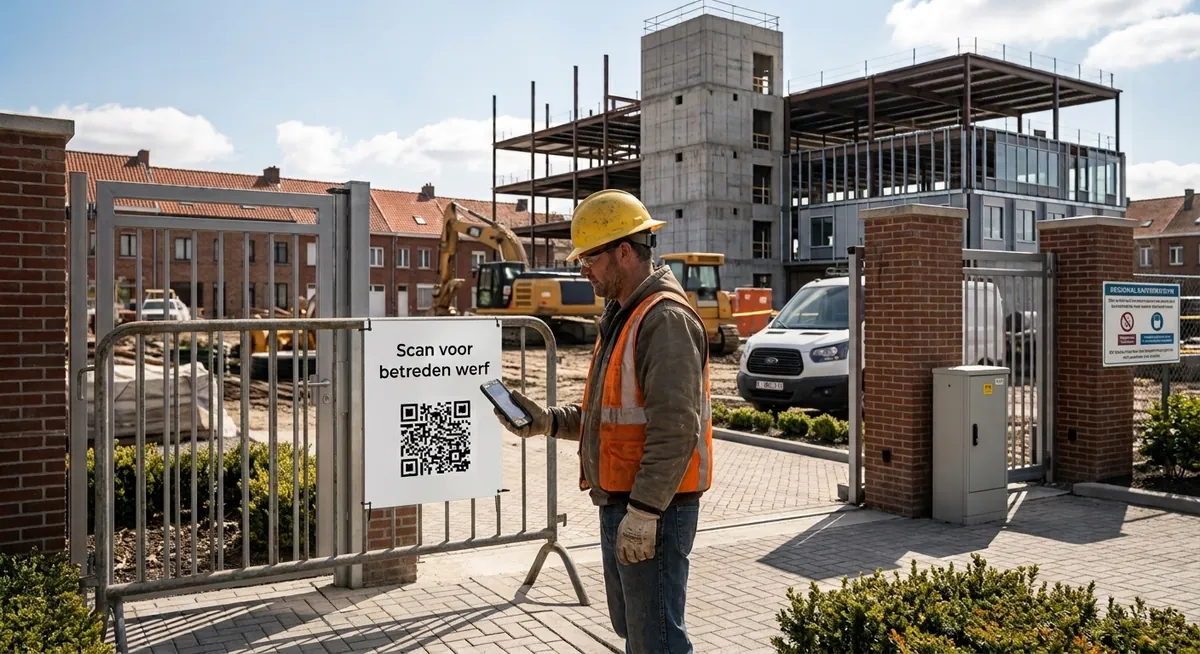
Check in at Work records, day by day, who is present on a site or at a workplace. Dimona tells the RSZ that someone starts or stops working for you, and for students and flexi-jobbers also when they work. Both end up at the RSZ, but through a different application. An app that records attendance does not automatically handle Dimona as well. Always ask.
In each case the registration covers everyone who does the work: your employees, but also self-employed workers and subcontractors' staff. And it has to be electronic. A paper list does not hold up when the social inspectorate checks.
If you work with a lot of temporary staff, you soon end up typing the same details three times: in the roster, on the social security portal and in the hours list for your social secretariat.
In Flextime your employees check in on site or at the client's premises in the way that suits their work:
You file the Dimona from the same record the employee is in. You declare a start, a departure or a change to the RSZ without typing the details again on the portal. For flexi-jobbers and students, Flextime prepares the contract and the Dimona from the roster, and the framework agreement a flexi-jobber signs once is signed in the app.
Hours per employee and per site sit in the same overview, together with leave. Each month you export them for your social secretariat, and hours per project or client are ready to invoice or to cost.
Dimona, Check in at Work and Check in and out at Work are part of Flextime Standard: €50 a month billed yearly, or €58 a month, for up to 30 employees. You pay per company, not per employee. Your free trial runs for 14 days, and we help you set it up.
Comparing apps? Ask everyone the same questions, us included:
Not sure which rules apply to your sites or contracts? Ask your social secretariat as well.
Is your question not listed? Call +32 56 50 50 50 or e-mail info@flexwise.be.
Yes. In Flextime Standard your employees check in on site or at the client with a QR code, the app, a tablet or a badge, and you declare a start, a departure or a change to the RSZ from the same record. Hours, leave and the export to your social secretariat are in the same system.
Check in at Work records every day who is present on a site or at a workplace. Dimona tells the RSZ that someone starts or stops working for you, and for students and flexi-jobbers also when they work. They are two separate declarations.
From 1 April 2027 it is, on sites worth €500,000 or more excluding VAT: Check in and out at Work then applies, with a registration on arrival and on departure. In cleaning that has applied since 1 September 2024, breaks included. In the meat industry, arrival is enough.
No. Registration in Check in at Work and Check in and out at Work has to be electronic. A paper list does not hold up when the social inspectorate checks.
They are part of the Standard plan: €50 a month billed yearly, or €58 a month, for up to 30 employees. You pay per company, not per employee, and the free trial runs for 14 days.

Five questions before you choose a time registration app: price per employee or per company, ways to clock in, projects and invoicing, Dimona and Check in at Work, and help getting started.
Will time registration be mandatory in Belgium in 2027? What the draft bill asks, who is covered, whether a time clock or spreadsheet will do, and what you can do now.
From 1 April 2027, workers on Belgian sites worth €500,000 or more register departure as well as arrival (CIaO). What changes, which sites, how to prepare.
Request your free trial. We will call you within two working days to set everything up together.
Flextime is a product of Aditco Flexwise from Roeselare, Belgium, developed and hosted in the EU. We also offer mobile plans, VoIP, business internet and custom software (site in Dutch).
Start now and pay nothing until 1 January 2027. Prepare for the planned obligation at no cost, so your team already knows the system by then.